An Almoravid capital
Aghmat became an Almoravid political centre in the eleventh century before the foundation of Marrakesh, giving special significance to its craft and architectural remains.
A documentary dossier bringing together historical testimony, written sources and material evidence to highlight the authenticity of Moroccan zellige and its development across the centuries.
A reference document intended for members of the Intergovernmental Committee for the Safeguarding of the Intangible Cultural Heritage.
This study examines Moroccan zellij through dated texts, monuments, records of local production, technical analysis and craft transmission in Fez, Meknes, Tetouan and Marrakech. These sources support Morocco’s claim to attribution of its documented tradition, safeguarding its knowledge and skills, and protecting product names through appropriate instruments. Each conclusion is tied to the nature, date and scope of the evidence.
Fez and Tetouan: centres of production and craft knowledge
This study does not ask the Committee to decide a question of cultural “ownership”. It asks whether the Algerian nomination demonstrates, within its own file, that the element entitled “zellidje, glazed ceramic” meets all five criteria R.1–R.5 of the Representative List.
An original UNESCO Archives card explicitly connects Morocco, Fez and zellig / zelliges within the international campaign for the safeguarding of the Medina of Fez.

This original 1978 UNESCO Archives record relates to the rehabilitation of Fez’s historic medina, a project established in agreement with the Moroccan government within the international safeguarding campaign decided by UNESCO’s General Conference in 1976.
Its particular documentary value lies in UNESCO’s own explicit use of “zelliges / zellig decoration” to describe the ornament of Fez’s Nejjarine Fountain, within the 1978 documentation of Fez.
Morocco ← Fez ← zellij
For Committee members: any assessment of a nomination concerning this craft should take account of such earlier institutional records, the documented Moroccan tradition and the continued transmission of its techniques. This record clearly establishes the historical association, although it does not itself confer an exclusive legal right of cultural ownership.
Source: UNESCO Archives — Dominique Roger — Fez, Morocco — 1978 — PHOTO0000002039.
Before becoming a major feature of contemporary architecture and design, zellige developed through a long history of clay, fire, glazing, geometry and manual skill. In Fez, Marrakesh, Meknes and other Moroccan cities, the tradition appears through a cumulative chain of evidence: historical texts, dated monuments, craft techniques, independent archives and a living practice.
The central question is therefore not simply where the earliest glazed ceramic was found, but where a complete technical and craft sequence can be traced: raw material, firing, glazing, cutting, geometric assembly, transmission from master to apprentice, and continuity from the historical workshop to the present-day craft.
This study brings medieval texts, archaeological data and material evidence into dialogue with living practice. It distinguishes different forms of architectural ceramics and follows the development of Moroccan zellige toward its mature Marinid form while situating it within earlier traditions of paving and ceramic revetment.
This distinction allows tesserae, tiles, mosaics, pavements and cut-and-assembled zellige to be compared with technical precision rather than treated as interchangeable categories.
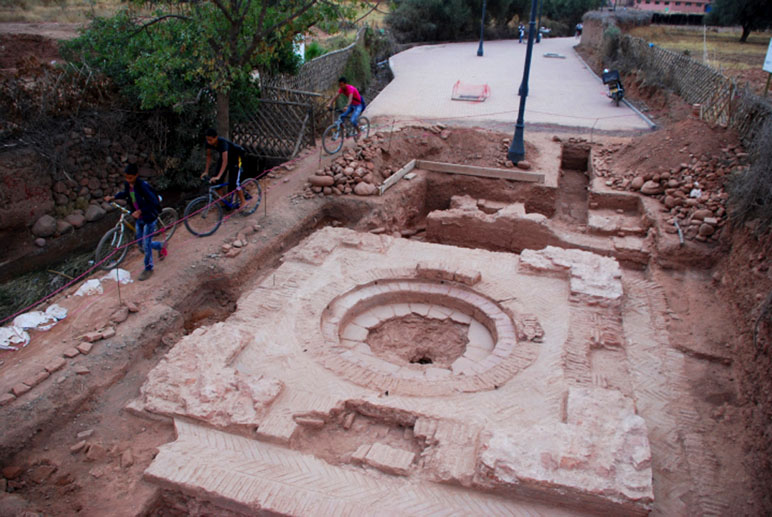
The excavations at Aghmat, about 30 km south of Marrakesh, provide an important archaeological sequence for understanding the formation of Moroccan traditions of glazed ceramics, paving and architectural decoration before their later Almohad and Marinid development.
The Aghmat Archaeological Mission notes that the city was already flourishing in the Idrisid period and became an imperial capital when the Almoravids took control in the eleventh century. Archaeological research places the main development phase of the monumental quarter in the eleventh and twelfth centuries, precisely the period in which Aghmat was an Almoravid political and economic centre.
Excavations have uncovered a large bathhouse, palace complex, mosque, elite residences, hydraulic systems, pools, carved stucco and geometric decoration. Archaeology Magazine also reports substantial quantities of glazed cuerda seca pottery. Unfinished and defective pieces led researchers to consider local production, indicating a resident craft community with advanced knowledge of forming, glazing and firing ceramics.
Decorative pavements, pools and architectural revetments around the mosque and residential areas place Aghmat within an early Moroccan architectural environment in which ceramic technology, geometry, water and decoration were closely connected.
Aghmat became an Almoravid political centre in the eleventh century before the foundation of Marrakesh, giving special significance to its craft and architectural remains.
The cuerda seca finds, including unfinished and misfired pieces, support the presence of local ceramic production and specialised craftspeople.
Palace, mosque, pools, stucco and decorated floors reveal a sophisticated built environment in which ornamental and geometric techniques were already highly developed.
Aghmat remained occupied after the political centre shifted to Marrakesh. Fourteenth-century excavations later document polychrome zellige tiles preserved in situ in an elite residence.




Ibn Abi Zar's passage documents an early ceramic paving phase in Fez. Assigning the earlier pavement specifically to a late-tenth-century Zenata phase still needs firmer archaeological evidence.

ArchéoSciences cites these late-twelfth-century minarets among the earliest Moroccan zellij examples, using large monochrome tiles in geometric compositions.
Persée study →An early Western monograph discussing zellij in Fez and Meknes.
SourcePhotographic and architectural documentation explicitly cataloguing Moroccan decoration as “Zellij”.
QNLMaterial Marinid evidence linking texts to surviving architectural technique.
StudyAn early specialised study of North African decorative tiles, giving substantial attention to Fez and Meknes as major centres of zellige production.
Early architectural and photographic documentation of Moroccan monuments, using zellij terminology in descriptions of decorative work in Fez, Meknes and Marrakesh.
A dated material witness to the technical maturity of zellige in Marinid Fez, linking medieval sources to surviving architectural practice.
Ibn Abi Zar al-Fasi records the repaving of al-Qarawiyyin's courtyard in Rawd al-Qirtas. He names the master Muhammad b. Ahmad b. Muhammad al-Khawlani and mentions the manufacture of “brick resembling bejmat”, together with a detailed account of levelling and water drainage. The text also states that an earlier pavement had existed.
A cautious sequence can be proposed: large paving units / bejmat → wider glazed-tile use → zellij in floors and wall dados → small cut pieces assembled geometrically in the Marinid period. Al-Umari's testimony is central because he describes zellij in Fez floors and wall dados.
Muhammad b. al-Qasim al-Subti explicitly describes a basin “paved with coloured zellij”, providing direct Moroccan textual evidence from the early fifteenth century.
View source →Museum With No Frontiers describes a Hammadid panel made of moulded, enamelled and lustre-painted ceramic; its stars and crosses are about 21 cm in diameter. These are large moulded elements, not necessarily small units created by post-firing cutting.
By contrast, the ArchéoSciences study of fourteenth-century Moroccan zellij describes a process in which tiles are glazed and fired, then cut and finally assembled into geometric panels.
Museum With No Frontiers →A recent study of Fez clays shows that potters traditionally use two clay types from the Benjlik site, fine and sandy clays from Miocene deposits in the Fez basin. Their mineralogical and chemical composition and their ceramic suitability have been scientifically characterized.
Historical sources and archaeological studies show that relations between Morocco and al-Andalus involved real movements of craftsmen, master builders and technical knowledge.
For the construction of Seville's great mosque in 567 H / 1172, Ibn Sahib al-Salat records the participation of master builders from Marrakesh, Fez and the Maghribi shore alongside Andalusi craftsmen.
In the sixteenth century, Luis del Mármol Carvajal states that the rulers of Granada acted « a imitación de los reyes de Fez » and adds that « los reyes de Granada siempre fueron imitando a los de Fez ».
Antonio Malpica Cuello points to « interesantes paralelos » between Marinid and Nasrid ceramics and describes them as « estrechamente ligadas ». Research by the Patronato de la Alhambra further notes that a precise ceramic-inlay technique is documented, as far as currently known, only in Nasrid and Marinid art.
Photographs of urban spaces and fountains document zellij in everyday city life, not merely as a museum object, long before current heritage disputes.
If the archival metadata is confirmed, the image combines Morocco, a Fez craftsman, zellij and a public technical demonstration. This documents living craft knowledge, not only decoration.
The archive illustrates a methodological rule: the presence of tiles in a building does not prove local origin. Some tiles are explicitly identified as imported, including Delft ware. Place of use must be distinguished from place of production and technical origin.
The Louvre exhibition “Le Maroc médiéval – Un empire de l’Afrique à l’Espagne”, held from 17 October 2014 to 19 January 2015, presented the eleventh to fifteenth centuries through the Almoravid, Almohad and Marinid dynasties centred on Morocco, whose political and artistic reach extended into northern Algeria and Tunisia.
In the Department of Islamic Art, display case 56B is titled “Maroc, 1300–1500 – Le décor architectural”. It includes ceramic mosaic elements discovered at the Sidi Boumediene Mosque in Tlemcen, including objects 74.1962.518 and 74.1962.520.
Charles Thomas-Stanford, in About Algeria (1912), describes Mansourah as the city built by Abu Yaqub, king of Fez, during the siege of Tlemcen. When discussing Sidi Boumediene, he notes tiles that were said to be partly of Moroccan origin.
Cook’s Practical Guide to Algeria and Tunisia (1908) states of the Sidi Boumediene Mosque: “The Mosque is rich in tile mosaics, some of which are said to have been made in Morocco.” The same guide attributes the neighbouring madrasa to the Marinid Abu al-Hasan and Mansourah to Abu Yaqub.
Under the logic of the 2003 Convention, the decisive factor is the human chain still practising the technique: masters, apprentices, kilns, pigments, cutting, tools, templates, geometric calculation and assembly.
International safeguarding campaigns for the medina of Fez have documented the urban fabric and traditional crafts since the 1970s, showing that the Fez-zellij association predates the current dispute by decades.
Workshops and institutions explicitly linked to zellij show an organized economic and cultural practice. The evidentiary value lies in the skills maintained inside them, not merely in the commercial name.
The use of Fez-made zellij in modern projects abroad shows a craft that is still produced, exported and integrated into contemporary architecture.
Following an official Moroccan protest and discussions with Morocco’s Ministry of Culture, Adidas announced on 14 October 2022 a “positive resolution” of the dispute and acknowledged that the Algerian jersey design was “indeed inspired by the Zellige mosaics pattern”. The company also expressed deep respect for the people of Morocco and its craftsmen and regretted the controversy.
The international registration shows that Morocco has for years regulated and protected a designation and commercial identity linked to Fez zellij. It does not mean WIPO ruled that all zellij worldwide belongs to Morocco.
This is the principal vulnerability. File 02280 groups under “zellidje, glazed ceramics” Hammadid tesserae from Béjaïa, medieval decoration in Tlemcen and contemporary practice in Tipasa. Ancient architectural ceramics do not by themselves prove that these materials belong to the same living element or to one transmitted technical chain.
R.2 requires inscription to encourage dialogue and reflect cultural diversity. Where zellij is documented across several parts of the Maghreb and al-Andalus, the nomination should distinguish local forms and acknowledge the shared regional context rather than imply exclusivity over a broad regional concept.
Safeguarding measures should protect transmission through masters, apprentices, workshops, gestures, geometric knowledge and the production chain. Monument restoration or commercial promotion alone is not equivalent to safeguarding living intangible heritage.
UNESCO's portal indicates that community consents were submitted, so R.4 should not be described as absent. The relevant question is qualitative: do the signatories represent the diversity of practitioners, and did communities participate in defining the element itself?
An inventory extract is present, but the name, technical definition, bearer communities and geographical scope in the inventory should correspond to the element nominated as “zellidje”. If the inventory covers a broader glazed-ceramics category, that correspondence requires scrutiny.
The “Zellige de Fès” certification mark protects provenance and manufacturing standards; it is not an international ruling of exclusive ownership over all zellij.
After examining the historical, archaeological and technical evidence underlying Algerian nomination 02280, and comparing it with specialist definitions of zellige and the requirements of the 2003 Convention, the central question is whether the nomination demonstrates that the various pieces of evidence grouped under “zellidje” constitute one living element with a technically and historically continuous chain of transmission.
The nomination brings together ancient tesserae and ceramics, medieval decoration from Tlemcen and contemporary practice. Chronological succession alone does not necessarily establish technical and craft continuity. The Committee should therefore examine continuity in production methods, tools, terminology, practitioner communities and modes of transmission.
Under R.1, the element should be defined precisely enough to distinguish it from the wider field of glazed architectural ceramics. R.4 and R.5 likewise require careful examination of community participation and of the correspondence between the nominated element and the national inventory entry.
The Moroccan comparison shows a documentary chain linking dated medieval monuments, written sources, independent archives, workshops, masters, apprentices and living transmission. This is not a request for UNESCO to award exclusive cultural ownership; it is a call for a technically and historically precise definition of the nominated element.
Accordingly, if the Committee considers that the element’s definition and its technical and historical continuity have not been sufficiently demonstrated, nomination 02280 should not be inscribed in its current form.
At a minimum, if the shortcomings are considered remediable, referral should be considered so that the title and scope can be clarified, glazed ceramics, tiles, mosaics and cut-and-assembled zellige can be clearly distinguished, and stronger evidence of continuity between historical evidence and contemporary practice can be supplied.
Such a decision would not be a position against Algeria; it would protect the scientific precision of the Representative List and the credibility of the 2003 Convention system.
In his account of urban prosperity under the Marinid ruler Abu al-Rabi‘, Ibn Khaldun mentions residences and palaces ornamented with zellij and carved decoration. This testimony ties the word to domestic architecture in Fez in the early fourteenth century (Arabic dossier ref. [29]).
Abdelnour Ben Kharrach of the University of Algiers 2 studied composite ceramic-and-marble mosaics at the Qal'a in the Journal of Archaeological Studies, vol. 21, no. 1 (2023), pp. 115–130. It describes the production and assembly of the finds, providing a more precise technical basis for comparing regional traditions.
In Les monuments arabes de Tlemcen, the authors distinguish Moroccan and local terms: “Xelij est marocain; à Tlemcen, on dit plutôt zellâij” (“Xelij is Moroccan; in Tlemcen one more often says zellâij”). They also describe mosaic pieces cut from larger monochrome tiles and mention production in Tetouan. Digitized source.
Abbas ibn Ibrahim al-Marrakushi, in Al-I‘lam bi-man halla Marrakush wa Aghmat min al-a‘lam, records a visit in 1149 AH to a finely constructed house named “Dar Zellij”. This is evidence for the term's continued use in eighteenth-century Marrakech (ref. [28]).
Godard's Description et histoire du Maroc (Paris, 1860) describes Moroccan exports passing through Fez, Taza and Oujda toward Oran. Among Fez products he explicitly lists “Les azulejos ou zelaïdj, carreaux de faïence peinte”, documenting a commercial connection in the nineteenth century (ref. [27]).
The Arabic dossier details Benjlik clay in Fez's traditional craft production. It also records the international marks ZELLIGE DE FÈS no. 1314783 (2016), MAROC PATRIMOINE ZELLIGE DE FÈS no. 1873639 (2025), and Moroccan OMPIC filings. These protect specific marks or processes rather than all architectural ceramics.
Moroccan patent MA 42179 B1, filed in 2018 and published in 2020, concerns an industrial zellij manufacturing process. OMPIC — MA 42179 B1.
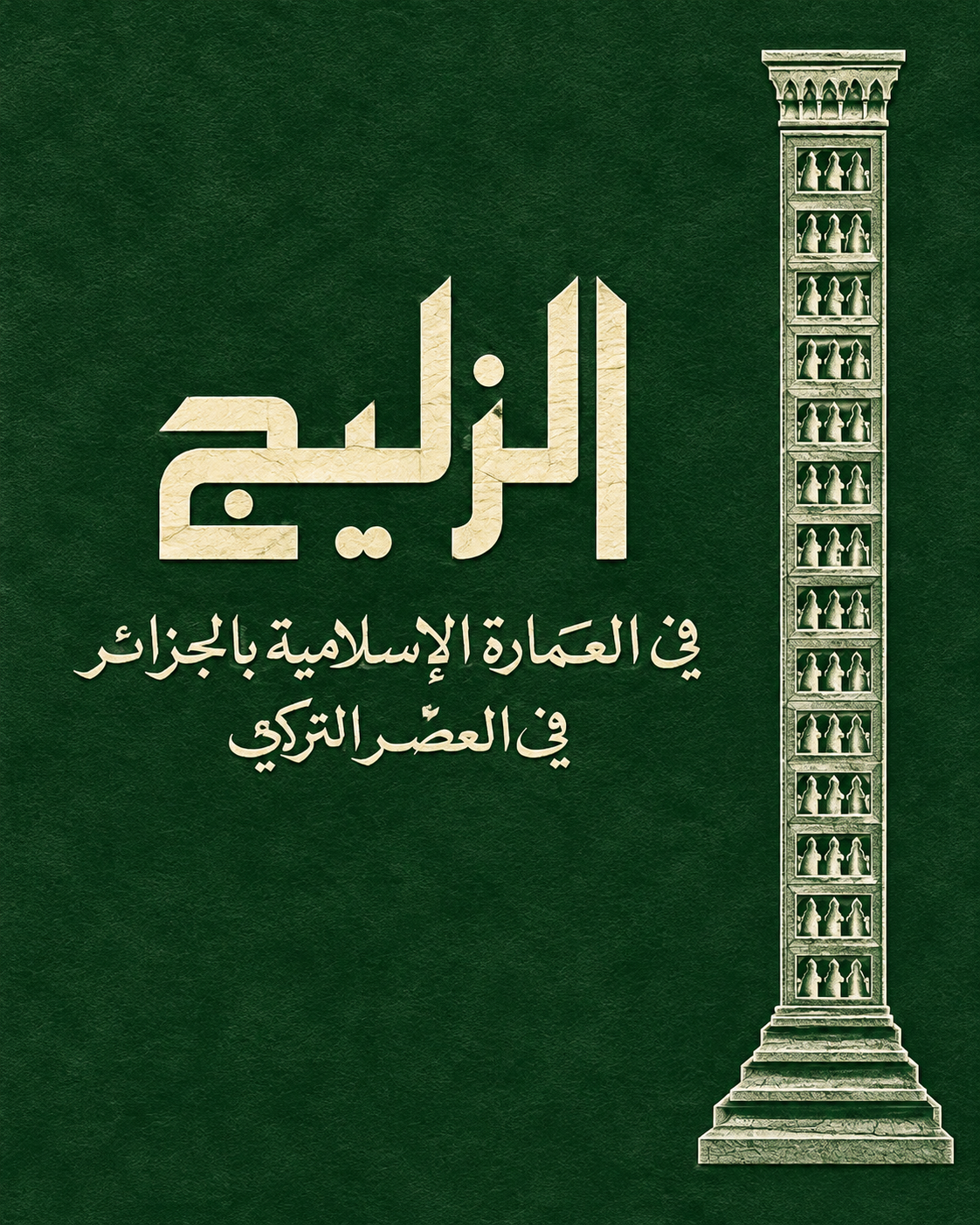
The author examines ceramic tiles in Ottoman-era Algerian architecture and their varied origins. On page 67, he notes the recruitment of craftspeople from Morocco by Tunisian production centres and highlights Fez as a major centre of the Moroccan-Andalusian zellij tradition.
This 1990 Algerian publication provides valuable historical testimony about production networks and the circulation of craftspeople, predating the contemporary heritage dispute.
Read the original study · Bibliographic record

The Grand Mosque of Paris provides a tangible example of the transmission of Moroccan craft expertise. Its zellij decoration is associated with artisans from Fez and Meknes. During the 2005 restoration, Moroccan craftspeople were employed again, using tiles and materials brought from Fez. Contemporary reporting describes their work as an effort to preserve the monument's traditional methods.
Le Parisien, 1 October 2005 · Le Matin / MAP, 2 October 2005
Independent review for members of the Intergovernmental Committee for the Safeguarding of the Intangible Cultural Heritage at its 21st session (2026). It compares the historical and technical evidence in nomination ICH-02 with criteria R.1–R.5. This is not an official UNESCO document.
The nomination cites eleventh-century ceramic remains to support the practice’s historical presence. These demonstrate architectural ceramic decoration, but geometric resemblance alone does not establish identical forming, cutting, glazing and assembly techniques to those used today. Material analysis would need to identify cutting before or after firing, tool marks and fixing methods. Criterion R.1 does not award exclusive origin or archaeological precedence; it concerns living heritage recognized by its communities.
The UNESCO photograph is expressly captioned as showing the fountain after restoration. Zahira Seddiki’s thesis (Constantine 3 University) describes 283.65 square metres of historic zellige and 1,300 square metres of recently restored zellige: approximately 17.9% and 82.1% of those two figures combined, not of the entire palace. Press reports mention Moroccan artisans taking part in works preceding the 2011 inauguration, but contracts or work records are needed to attribute specific surfaces. The date and makers of the tiles visible in the nominated photograph should be distinguished from the date of the monument.
Official captions describe shaping an eight-pointed clay star, assembling unglazed pieces, and applying glaze by brush. These are ceramic operations, but do not on their own document the whole production chain. The Fez technique includes cutting glazed tiles after firing, while other historic Moroccan methods have involved cutting before firing. The workshop’s tools, finished products and full film should therefore be matched to the element’s stated definition without treating one regional technique as universal.
The nomination describes family workshops, vocational training and international experts. These can coexist, but the pathways should be documented by identifying the communities, the skills transmitted and the training content. General aid for ceramists does not automatically show dedicated safeguards for geometric planning, tile cutting and mosaic assembly. Measures, implementers, budgets and monitoring indicators need to be distinguishable.
The nomination names the Ayadi El Djazaïr association and other craftspeople and cites inventory entry 2023/A/03 dated 24 October 2023. UNESCO lists consent and inventory attachments, so their existence is not in dispute. The question is whether their contents establish informed participation and consistent definitions of the element.
Paragraph 3 proposes inscription; it is not yet a final adopted decision. Paragraph 4 stresses that inscription confers neither an exclusive origin nor ownership or intellectual-property rights in intangible heritage. This legal limit does not decide the craft’s historical origin or excuse inaccurate supporting documentation. Algeria holds a vice-presidency of the Committee Bureau, but that office alone does not establish improper pressure.
The Operational Directives allow referral when information is insufficient to assess one or more criteria. A dispute over historical priority alone is not enough. Any request for clarification should identify a concrete evidentiary gap tied to R.1–R.5 and establish whether the evaluation report, full film or attached records already address it.
The Moroccan dossier assembles textual, architectural and technical sources, including Aghmat, Fez and UNESCO’s 1978 record of the Nejjarine Fountain. The Algerian examples raise testable questions about the Hammadid fragments’ technical relationship to present practice, the dating of restored El Mechouar decoration and the Tipaza demonstrations. These questions should not be represented as a final finding on eligibility without examining the complete official record.
The review of Algerian nomination 02280 does not question Algerian communities' right to safeguard their ceramic heritage. It asks whether the nomination demonstrates a single transmitted living element connecting Hammadid tesserae, Tlemcen decoration and contemporary workshops. Glazed ceramics, tiles, mosaics and cut-and-assembled zellige are not synonymous, and visual resemblance across centuries does not by itself prove continuity of technique.
The assessment should examine the definition and technical coherence of the element under R.1, actual bearer-community participation under R.4, and consistency between the nomination and national inventory under R.5. Morocco's historical and craft documentation, from medieval monuments to living workshops, underlines the need for precision without asking UNESCO to adjudicate exclusive ownership.
First: do not inscribe nomination 02280 in its present form if the complete record shows that the criteria are not met. Second: if deficiencies can be remedied, refer the file to the submitting State for clarifications on its definition, techniques, transmission, communities and inventory.
Third: if the Committee finds that the living practice meets the criteria, consider the title “The art of architectural ornamentation in glazed ceramics: associated knowledge and skills”, without “zellidje” in both the title and official description, provided the wording better reflects the documented practice, in consultation with the submitting State and communities and following applicable procedures. This is neither an automatic entitlement to rename another State's nomination nor a denial of Algeria's heritage. If clarification cannot procedurally be made during the session, referral remains the prudent option.
Primary references: UNESCO nomination 02280; draft decision 21.COM 7.b.32, paragraphs 3–4; Zahira Seddiki thesis, pp. 112–125; Médias24 (19 October 2022); ArchéoSciences (2003).
UNESCO — 02280 · UNESCO — photographs · Seddiki — thesis (PDF) · Médias24 — 2022
Verification status: official image captions and accessible nomination text have been reviewed, but full collation of all official annexes and frame-by-frame review of the film have not been completed. Independent research, not a UNESCO statement.
French and Spanish testimonies document Moroccan cities producing architectural ceramics and retaining the names of pieces, techniques and trades. Letters from 1905 and 1919 reveal the people behind this history: artisans, workshops and practical knowledge passed between generations.
On 19 June 1919, José Gómez Muros, Spain’s consular agent in Fez, wrote to architect Vicente Traver Tomás about decorating a private residence in Seville. He described differently coloured pieces assembled into geometric designs, distinguishing them from tiles bearing a complete painted design. He then proposed sending one or two Fez artisans with their tools. The letter documents the proposal; it does not by itself establish that the project was carried out.
Los artífices de Fez siguen trabajando el mosaico de azulejo como nuestros moros de los siglos XIII y XIV.“The artisans of Fez continue working tile mosaics as our Muslims of the thirteenth and fourteenth centuries did.” This historical comparison is the letter writer’s.
Writing to Benito Pérez Galdós on 23 February 1905, Ricardo Ruiz Orsatti identified tiles as an important, flourishing Tetouan industry. He supplied the local name “zul-lej”, describing varied shapes, durable glazing and use on floors and walls.
Otra de las industrias importantes de Tetuán, y ésta siempre floreciente, es la de los azulejos (zul-lej)“Another important industry of Tetouan, always flourishing, is that of tiles (zul-lej).”
Fez emerges as a centre of cutting and assembly expertise described by a Spanish consular correspondent; Tetouan as a production centre explicitly associated with the local name for zellij. Together with Chénier’s 1787 account of Fez and Meknes, the texts strengthen the record of Moroccan centres and craft transmission.
| Reference | Location and content | Verification |
|---|---|---|
| Charles Didier — Le Maroc, II. Tétouan (1836) | Revue des Deux Mondes, vol. 8, pp. 241–269: house courtyards and rooms paved with ceramics called asulejos; evidence of architectural use. | Accessible text examined |
| Lucien Magne — La céramique, lectures of 1910–1911 | P. 101: development of glazed earthenware mosaics in Morocco and Spain under Muslim rule, within a comparative technical account. | Accessible text examined |
| Alexandre Joly — L’industrie à Tétouan (1906) | Archives marocaines, vol. 8: glazed tiles p. 291; glazes p. 310; industrial and artistic assessment p. 319. Digitised text includes shapes, names and dimensions. | Reference identified • original requires collation |
| Juan Beigbeder — Los aliceres de Tetuán (1917) | In Guía del Norte de África y Sur de España, pp. 295–297: a description of Tetouan’s zellij craft. | Reference identified • original requires collation |
| Mauricio Capdequi — Los azulejos, industria africana (1918) | Memorial de Ingenieros del Ejército, March 1918, pp. 93–105: shapes, materials, glazes and colours. Issue identified at Spain’s Virtual Defence Library. | Reference identified • original requires collation |
| C. M. de Mendiluce — Los mosaicos tetuaníes: industria muerta (1915) | África Española, 26, 30 March 1915, pp. 285–287; reprinted in El Eco de Tetuán on 12 July 1923. Concerns over industrial decline and artisans’ employment. | Reference identified • original requires collation |
The last three Spanish references and their pagination are documented in Antonio Reyes Ruiz and María Dolores López Enamorado, Anaquel de Estudios Árabes, 36(1), 2025, pp. 37–51. They provide precise routes to the originals; no unexamined quotation is attributed to them. Read the source
These references document workshops in Fez and Moroccan architectural decoration, distinguishing historical text from modern archival descriptions.
Recherches historiques sur les Maures, et histoire de l’empire de Maroc, Paris, 1787.
On fait à Miquenès, ainsi qu’à Fez, des carreaux & des briques en fayance, vernissés de différentes couleursVolume III, pp. 59–60: coloured glazed earthenware tiles and bricks were made in Meknes and Fez, for paving rooms and lining walls. This explicitly documents local production of architectural ceramics; the passage does not detail zellij cutting and assembly.
Pierre Champion, Le Maroc et ses villes d’art, p. 84, chapter on Fez artisans, reporting the market inspector’s estimate:
Fès compterait vingt ateliers de zelliges“Fez is estimated to have twenty zellij workshops.” Evidence of production and craft organisation in the city.
French Diplomatic Archives, 20MA/10, inventory pp. 9–11: Attarine (57628) and Bou Inania (57678, 57686, 57688). The inventory transcribes instructions for colour photographs of zellij; not all original photographs have been examined.
Archives diplomatiques — 20MA/10, PDF
Alfred Bel, 1918, 319 pages. The BnF confirms the digitised edition; its technical passages await examination.
100 plates, four in colour; the Qatar National Library catalogue identifies zellij panels at Attarine, the Saadian tombs and Bou Inania in Meknes.
A photograph of an Attarine zellij panel was published on p. 46, according to the Qatar National Library record.
Henri Terrasse and Jean Hainaut, 1925; shelfmark CADN 8°4730. Bibliographic reference confirmed; zellij passages await examination.